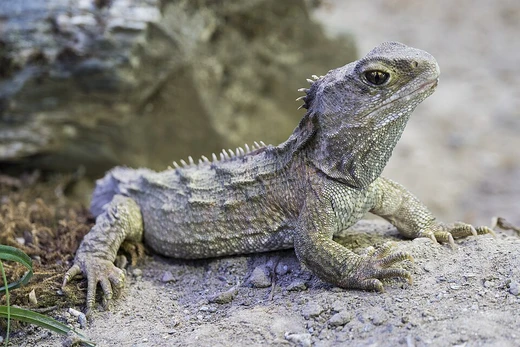
Diadectes
Early Permian herbivorous tetrapod, one of the first large land vertebrates.

It was one of the first herbivorous tetrapods and one of the first fully terrestrial vertebrates to attain large size, reaching up to 3 meters in length. Diadectes combined a reptile-like skeleton with a more primitive, seymouriamorph-like skull and has been classified as belonging to the sister group of the amniotes.
- length
- Up to 3 m (10 ft)
- diet
- Herbivorous
- type_species
- Diadectes sideropelicus
- known_from
- North America, especially Texas Red Beds
Lore & Background
Cope noted the transverse orientation of the tooth crowns, which inspired the generic name 'crosswise-biter.' He described the animal as 'in all probability, herbivorous.' The type species name sideropelicus alludes to the iron clay of the Wichita beds in Texas where the fossil was found. Numerous species have been assigned to Diadectes, though most have proven to be synonyms.
Reader's Guide
Diadectes holds significance as one of the earliest large terrestrial herbivores, demonstrating adaptations for high-fiber plant consumption that were advanced for its time. Its combination of primitive amphibian-like skull features (otic notch) and reptile-like postcranial skeleton illustrates the mosaic evolution occurring near the origin of amniotes. The reptile-like details of its skeleton, such as heavy vertebrae and robust limbs, are likely independently derived traits related to supporting a large trunk, representing convergent evolution with early amniotes like pelycosaurs and pareiasaurs. The taxonomic history of Diadectes, including the priority dispute with Nothodon and the later proposal of new genus names in an unpublished thesis, highlights ongoing challenges in paleontological nomenclature. dreigleichenensis, from Germany. Diadectes thus provides key insights into the evolution of herbivory, terrestriality, and the transition between amphibians and reptiles.
Did You Know?
- Diadectes was one of the first fully terrestrial vertebrates to attain large size, up to 3 m long.
- Its generic name 'crosswise-biter' refers to the transverse orientation of its tooth crowns.
- A juvenile Diadectes skeleton shows tooth marks from predators such as Varanops, Dimetrodon, or the amphibian Acheloma.
- The name Nothodon was published five days before Diadectes, but Diadectes is used as the senior synonym despite violating ICZN rules.
Frequently Asked Questions
How big did Diadectes get?
This animal could grow to lengths of up to about three meters, making it one of the earliest fully terrestrial vertebrates to reach genuinely large body size. For its era, that was an extraordinary stature for a land-dwelling creature.
What did Diadectes eat?
Diadectes was a plant-eater, subsisting on vegetation rather than other animals. It is recognized as one of the earliest known large herbivorous tetrapods, occupying a dietary niche that had been rare among land vertebrates before its time.
Why is Diadectes significant to paleontology?
It sits at a pivotal point in vertebrate evolution, blending a reptile-like skeletal plan with a more primitive seymouriamorph-style skull, and is classified as a close sister group to the amniotes. Its existence demonstrates that large, fully terrestrial plant-eating vertebrates emerged far earlier than many researchers once assumed.
More in Ancient Reptiles 1-24
Elsewhere in the Ancient Reptiles universe
Spotted an error? Know more?
This is a living reference — every entry is fact-audited, and reader corrections feed straight into our audit queue. Suggest an edit · See this site's audit record