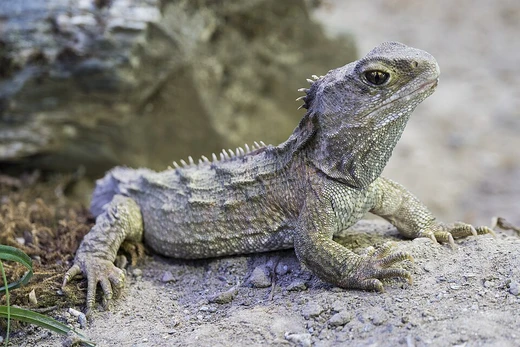
Drepanosauromorpha
Extinct reptiles with bird-like skulls and chameleon-like adaptations.

They are notable for their bird-like skulls, barrel-shaped bodies, and horizontally narrow tails, with many species possessing specialized grasping limbs and prehensile tails similar to those of chameleons. Their phylogenetic position remains highly disputed, with some studies placing them within Archosauromorpha (related to modern birds and crocodilians) and others considering them basal neodiapsids unrelated to any modern reptiles.
- key_characteristics
- Bird-like skull, barrel-shaped body, narrow tail, often prehensile tail and grasping limbs
- proposed_lifestyles
- Arboreal (tree-dwelling), possibly insectivorous; some studies suggest fossorial or aquatic habits
- fossil_locations
- North America (Arizona, New Mexico, New Jersey, Utah) and Europe (England, northern Italy)
- name_meaning
- From Drepanosaurus, 'sickle lizard,' referring to strongly curved claws
Lore & Background
Drepanosaurs are distinguished by their triangular, bird-like skulls; some, such as Avicranium, had pointed, toothless beaks. This resemblance led to the misattribution of a possible drepanosaur skull to the would-be 'first bird,' Protoavis. Many species possessed a specialized vertebral hump above the shoulders, possibly for rapid forward-striking head movements to catch insects. Their hands often had two fingers opposed to the remaining three, an adaptation for grasping branches, and some individuals of Megalancosaurus had a primate-like opposable toe, possibly used for extra grip during mating. Most species had broad, prehensile tails, sometimes tipped with a large claw, aiding in climbing.
Reader's Guide
Drepanosaurs represent a bizarre and ecologically diverse group of late Triassic reptiles whose exact relationships to other reptiles remain unresolved. Their combination of bird-like skulls, chameleon-like grasping limbs, and prehensile tails suggests a primarily arboreal, insectivorous lifestyle, though some studies propose fossorial or aquatic adaptations for certain genera. The group's disputed phylogenetic position—whether they are archosauromorphs, lepidosauromorphs, or basal neodiapsids—highlights the difficulty of classifying highly specialized extinct forms. Their fossils, found across North America and Europe, provide important evidence of the morphological experimentation that occurred among reptiles before the end-Triassic extinction. The inclusion of drepanosaurs within the clade Avicephala alongside gliding weigeltisaurids has been debated, and some analyses have even suggested a relationship with pterosaurs or kuehneosaurids, though these hypotheses remain controversial. Overall, drepanosaurs illustrate the complexity of Triassic reptile evolution and the challenges of reconstructing the tree of life for ancient, highly derived lineages.
Did You Know?
- The name Drepanosaurus means 'sickle lizard,' referring to their strongly curved claws.
- Some drepanosaurs, such as Avicranium, had pointed, toothless, bird-like beaks.
- A possible drepanosaur skull was misattributed to the would-be 'first bird,' Protoavis.
- Skybalonyx possessed claws similar in shape to modern moles and echidnas, suggesting humeral-rotation digging.
Frequently Asked Questions
What physical features make Drepanosauromorpha distinctive?
Members of this clade are recognized for their bird-like skulls, barrel-shaped torsos, and laterally compressed tails. Many species also developed grasping limbs and prehensile tails, giving them a chameleon-like appearance.
Where have Drepanosauromorpha fossils been found?
Fossil material has been recovered from both North America—specifically Arizona, New Mexico, New Jersey, and Utah—and Europe, including England and northern Italy. This transatlantic distribution suggests the group was fairly widespread across the supercontinent.
What do we know about how Drepanosauromorpha lived?
Most researchers interpret their grasping limbs and prehensile tails as adaptations for an arboreal, tree-dwelling lifestyle, with a likely insectivorous diet. However, some studies have proposed alternative habits, including fossorial or even semi-aquatic behaviors, so their exact ecology remains uncertain.
Why is Drepanosauromorpha's evolutionary placement so contentious?
The clade's phylogenetic position is one of the most debated questions in Triassic reptile systematics. Some analyses nest them within Archosauromorpha, making them distant relatives of modern birds and crocodilians, while other studies place them outside that group entirely, leaving their true affinities unresolved.
More in Ancient Reptiles 1-24
Elsewhere in the Ancient Reptiles universe
Spotted an error? Know more?
This is a living reference — every entry is fact-audited, and reader corrections feed straight into our audit queue. Suggest an edit · See this site's audit record