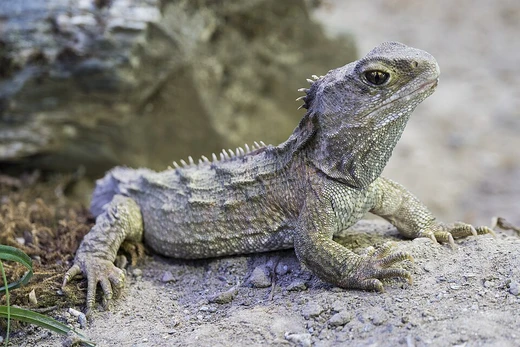
Dallasaurus
Small basal mosasauroid from the Upper Cretaceous of Texas.

Dallasaurus is a basal mosasauroid from the Upper Cretaceous of North America, known from two partial skeletons recovered in Dallas County, Texas. Along with Russellosaurus, it is one of the two oldest mosasauroid taxa currently known from North America and one of the smallest known mosasauroids, measuring approximately 1 meter in length.
- field
- Paleontology
- known_for
- One of the oldest and smallest mosasauroids; considered a 'missing link' between fully aquatic mosasaurs and terrestrial ancestors
- length
- Approximately 1 m (3.3 ft)
- era
- Upper Cretaceous (lower Middle Turonian)
- location
- Dallas County, north-central Texas
Lore & Background
The genus Dallasaurus is based on two partial skeletons from the Arcadia Park Shale, about 15 meters above its contact with the older Kamp Ranch Limestone. Both sites were temporarily exposed during excavations for a housing development and have since been reburied by construction. The genus is named for Dallas County, where both specimens were found.
Reader's Guide
Dallasaurus is significant as a basal mosasauroid that helps clarify the early evolution of mosasaurs. Bell and Polcyn's cladistic analysis placed it within the subfamily Mosasaurinae, well within Mosasauridae, and as the sister group to more derived mosasaurines such as Clidastes, Prognathodon, Mosasaurus, and Plotosaurus. Despite its small size and primitive limb condition, it was not placed within the paraphyletic family Aigialosauridae. The term 'plesiopedal' describes its conservative ecological grade: small size, slightly modified swimming tail, and relatively plesiomorphic limbs with elongated propodial elements (humerus and femur) constituting half or more of the full limb length. This contrasts with derived 'hydropedal' mosasaurs, whose propodial elements are stout and shortened. While hydropedal mosasaurs were probably entirely aquatic, plesiopedal forms like Dallasaurus were still capable of terrestrial locomotion and likely lived an amphibious lifestyle. In the popular press, Dallasaurus has been hailed as a 'missing link' uniting fully aquatic mosasaurs with their terrestrial ancestors.
Did You Know?
- Dallasaurus is one of the two oldest mosasauroid taxa known from North America, along with Russellosaurus.
- The holotype specimen includes an incomplete skull and considerable postcranial remains.
- Both specimens were discovered during excavations for a housing development and the sites have since been reburied by construction.
- The type species Dallasaurus turneri was named for amateur collector Van Turner, who found the first specimen.
Taxonomic Identity and the Smallest of the Sea Lizards
Dallasaurus turneri holds a distinctive place within the family Mosasauridae as the smallest known member of this group of extinct aquatic reptiles. Measuring under one meter—roughly 3.3 feet—this tiny creature stands in stark contrast to its more famous relatives, many of which exceeded four meters in length, with the largest species, Mosasaurus hoffmannii, once estimated at a staggering 17 meters (though later researchers have questioned whether that figure was inflated). Despite its diminutive stature, Dallasaurus was no less a true member of the order Squamata, the same clade that encompasses modern lizards and snakes. Dallasaurus turneri thus represents the lower extreme of a family whose members ranged from this modest, meter-scale predator to the ocean-dominating giants of the Late Cretaceous seas.
Feeding Ecology of a Small Predator
As a member of the smaller mosasaur genera, Dallasaurus occupied a distinctly different ecological niche from the ocean's apex predators. While giants like Mosasaurus hoffmannii could reach eleven meters and nearly four metric tons, Dallasaurus and its close relatives, including Platecarpus, fell within the one-to-six-meter range and likely subsisted primarily on fish and other small aquatic prey. This dietary specialization set them apart from species with blunt, spherical teeth adapted for crushing mollusk shells, or from the massive jawed predators that could swallow seabirds, marine bony fish, sharks, and even smaller mosasaurs nearly whole. The flexible, double-hinged skulls characteristic of the family would have allowed Dallasaurus to open its mouth wide enough to capture slippery fish in the warm, shallow waters it inhabited. Notably, smaller mosasaurs of this size class may have ventured into freshwater environments to hunt, suggesting a degree of habitat flexibility that larger, ocean-bound species likely did not enjoy. Dallasaurus thus represents a versatile, mid-level predator in the Late Cretaceous aquatic food web.
Body Plan and Aquatic Adaptations
Despite its small size, Dallasaurus shared the full suite of aquatic adaptations that made mosasaurs such successful marine reptiles. Like all members of the family, it breathed air and was a powerful swimmer, perfectly suited to the warm, shallow inland seas that dominated the Late Cretaceous landscape. Its body would have been elongated and streamlined—reminiscent of a modern monitor lizard but more hydrodynamic—supported by reduced limb bones ending in webbed paddles formed by long finger and toe bones connected by membranes. The tail, broad and laterally compressed, terminated in a fluke-like structure that served as the primary engine of propulsion. Rather than undulating its entire body like a sea snake, Dallasaurus likely kept its torso stiff to minimize drag while driving forward with powerful tail strokes. It probably gave birth to live young, never needing to return to shore. Its skin was likely covered in small, overlapping, diamond-shaped scales similar to those of modern snakes, with keeled scales on the upper body and smoother ones below, providing a nonreflective surface ideal for stealthy hunting in shallow waters.
A Survivor of a Dominant Era, Lost to the K-Pg Boundary
Dallasaurus turneri lived during the final stretch of the Cretaceous period, spanning the Turonian through Maastrichtian ages, a window of roughly twenty million years. During this interval, the extinction of the earlier marine reptile groups—the ichthyosaurs and pliosaurs—opened the door for mosasaurids to become the dominant predators of the world's oceans. Dallasaurus, though small, was part of this remarkable radiation of aquatic squamates that filled every available ecological niche, from the tiniest fish-hunter to the ocean's undisputed apex predator. Yet this era of dominance came to an abrupt end. The K-Pg mass extinction event, occurring approximately sixty-six million years ago, wiped out the entire family Mosasauridae along with the dinosaurs and countless other species. Dallasaurus turneri, the smallest of the sea lizards, vanished without a trace, leaving behind only fossilized bones and the faint impressions of scales in ancient sediment. Its story is inseparable from the broader arc of Cretaceous marine life: a brief, brilliant chapter of evolutionary success closed forever by a single catastrophic boundary.
Frequently Asked Questions
What is Dallasaurus?
Dallasaurus is a small, early mosasauroid that lived during the Upper Cretaceous in what is now north-central Texas. It is known from two partial skeletons and ranks as one of the earliest members of the mosasaur lineage found on the North American continent.
How big was Dallasaurus?
At roughly one meter (about 3.3 feet) in total length, it is among the tiniest mosasauroids ever identified. This modest size stands in stark contrast to the enormous marine predators like Tylosaurus that appeared later in the group's evolutionary history.
Where and when did Dallasaurus live?
Its fossils were recovered from Dallas County, Texas, and date to the lower Middle Turonian stage of the Upper Cretaceous. Along with Russellosaurus, it is one of only two mosasauroid taxa currently recognized from North American rocks of that age.
Why is Dallasaurus significant to paleontologists?
Because it sits near the base of the mosasauroid family tree, it helps bridge the gap between fully aquatic mosasaurs and their more terrestrial, lizard-like ancestors. Researchers regard it as a transitional form that illuminates how these animals first shifted into a marine lifestyle.
How does Dallasaurus compare to Russellosaurus?
Both are among the oldest and smallest mosasauroids known from North America, and they were identified from the same general region and time window. Together they offer a rare early snapshot of mosasaur evolution on the continent before the group diversified into larger, more specialized marine forms.
More in Ancient Reptiles 1-24
Elsewhere in the Ancient Reptiles universe
Spotted an error? Know more?
This is a living reference — every entry is fact-audited, and reader corrections feed straight into our audit queue. Suggest an edit · See this site's audit record