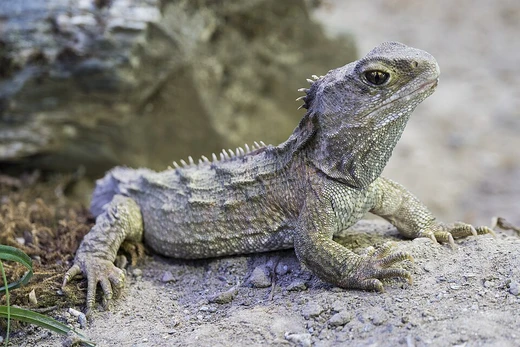
Hypsilophodon
Small, agile herbivore from the Early Cretaceous of England.
Hypsilophodon is a genus of neornithischian dinosaur from the Early Cretaceous of England. It was long classified as an early ornithopod, though newer studies have challenged that placement. Most of its fossils come from the Isle of Wight, giving a clear picture of its anatomy.
The first remains turned up in 1849. The type species, Hypsilophodon foxii, was named in 1869. It was a small, quick, two-legged plant-eater, about 1.5 to 2 meters long and weighing 20 kilograms. Its pointed head had a sharp beak, like a modern parrot, for snipping off vegetation.
Several old, outdated studies led to mistaken ideas about Hypsilophodon—for instance, that it was armored, lived in trees, or occurred outside the Isle of Wight. Later research has disproven all of that.
**Discovery and history**
**First specimens and the debate of distinctiveness**
The first Hypsilophodon specimen was found in 1849 when workers dug up what became known as the Mantell-Bowerbank block from the Wessex Formation, part of the Wealden Group, on the Isle of Wight’s southwest coast. The larger half—seventeen vertebrae, rib fragments, a coracoid, parts of the pelvis, and hindleg pieces—went to naturalist James Scott Bowerbank. The other half—eleven tail vertebrae and more hindleg parts—went to Gideon Mantell. After Mantell died, his portion went to the British Museum; Bowerbank’s was acquired later, reuniting the two halves. Richard Owen studied both and, in 1855, published a short paper calling the specimen a young Iguanodon, not a new type. That view held until 1867, when Thomas Henry Huxley compared the vertebrae and foot bones more carefully to Iguanodon and decided it was a different animal. The next year, Huxley saw a fossil skull that William Fox had found in the same area and put on display at a British Association meeting. Fox thought it might be a young Iguanodon or a new small species in that genus. Huxley noticed its unusual teeth and toothless front upper jaw, which resembled Iguanodon’s but were clearly distinct. He concluded this skull, too, belonged to a separate animal. After losing track of the specimen for months, Huxley asked Fox for permission to study it in detail. Fox agreed, and Huxley began work.
Huxley first announced the new species in an 1869 lecture; the published text of that lecture serves as the official naming paper, since it included a sufficient description. He named the species Hypsilophodon foxii, with the Fox skull as the holotype (now NHMUK PV R 197). The next year, Huxley published a full description. In the same block as the Fox skull, a dorsal vertebra centrum was preserved, allowing comparison with the Mantell-Bowerbank block and confirming it was the same species. Fox also confirmed the block came from the same geological layer as his material. Huxley therefore described that specimen as well; it became the paratype, its two pieces now registered as NHMUK PV OR 28707 and NHMUK PV OR 39560–1. Later that year, Huxley classified Hypsilophodon in the family Iguanodontidae, alongside Iguanodon and Hadrosaurus. A common misunderstanding later arose about the name’s meaning. It is often translated as “high-ridged tooth” from Greek, but Huxley actually intended it to echo the naming of Iguanodon (“iguana-tooth”): he chose the herbivorous lizard Hypsilophus and combined its name with the Greek word for “tooth.” Hypsilophodon therefore means “Hypsilophus-tooth.” The Greek word hypsilophos means “high-crested,” referring to the lizard’s back frill, not to Hypsilophodon’s own teeth, which are not high-ridged. The species name foxii honors Fox.
Reaction to Huxley’s proposal of a new genus was mixed. The question mattered because people wanted more information on Iguanodon’s form, especially its skull anatomy. If the Cowleaze Chine fossils belonged to a different genus, they were no longer useful for that purpose. Some paleontologists, like William Boyd Dawkins and Harry Seeley, supported the distinction, but Fox rejected it and took back his skull, giving it to Owen to study. To settle things, John Whitaker Hulke returned to the Hypsilophodon fossil bed on the Isle of Wight for more material. He noted that the whole skeleton seemed present but that fragility made excavation difficult. He published a description of his new specimens in 1873, and after examining the new teeth, he echoed Fox’s doubts. Owen then published a detailed comparison of the teeth of known Iguanodon and Fox’s specimens. He agreed there were differences but found them insufficient to justify a separate genus, so he renamed the species Iguanodon foxii. By then, however, Hulke had changed his mind after obtaining two more specimens.
- field
- Paleontology
- known_for
- Small, agile bipedal herbivorous dinosaur from the Early Cretaceous of England
- length
- 1.5–2 m (4.9–6.6 ft)
- weight
- 20 kg (44 lb)
- diet
- Herbivore
- era
- Early Cretaceous
Lore & Background
Hypsilophodon is a neornithischian dinosaur from the Early Cretaceous of England, traditionally placed within Ornithopoda though recent research has questioned this. The genus name, meaning "Hypsilophus-tooth," was coined by Thomas Henry Huxley in 1869, drawing on the name of an extant herbivorous lizard rather than describing the dinosaur's own teeth; the specific name *foxii* honors William Fox, who discovered the first skull. The first remains were found in 1849 on the Isle of Wight within the Wessex Formation, and abundant subsequent fossils from the same area have provided a clear picture of the animal. It was a small, agile bipedal herbivore with a pointed head and a sharp beak, similar to modern parrots, used for biting off plant material. Outdated studies once incorrectly suggested it was armoured, arboreal, or lived outside the Isle of Wight, but later research disproved these ideas. The initial specimen, known as the Mantell-Bowerbank block, was originally thought by Richard Owen to be a young *Iguanodon*, but Huxley’s detailed comparison of vertebrae, metatarsals, and the distinctive dentition and edentulous premaxilla of Fox’s skull led him to recognize a distinct genus. Huxley first announced the new species in an 1869 lecture, with the Fox skull as the holotype, and published a full description the following year. The Mantell-Bowerbank block, found in the same geological bed, was designated the paratype. Huxley initially classified *Hypsilophodon* within Iguanodontidae, alongside *Iguanodon* and *Hadrosaurus*.
Reader's Guide
Hypsilophodon is significant as one of the best-known small herbivorous dinosaurs from the Early Cretaceous, with abundant fossils from the Isle of Wight providing a detailed picture of its anatomy. It was a small, agile bipedal herbivore, measuring 1.5–2 m long and weighing 20 kg, with a pointed head and a sharp beak used to bite off plant material, much like modern parrots. Outdated studies gave rise to misconceptions that it was armoured, arboreal, or found outside the Isle of Wight, but later research corrected these ideas. The genus has been central to debates about ornithopod classification, and while traditionally placed in Ornithopoda, recent research has questioned that assignment. A second species, Hypsilophodon wielandi, was proposed in 1979 based on a femur from South Dakota, but it is now considered a dubious basal ornithopod, leaving H. foxii as the only valid species.
Did You Know?
- The generic name Hypsilophodon means 'Hypsilophus-tooth', after an extant herbivorous lizard, not because of high-ridged teeth.
- Some outdated studies incorrectly suggested Hypsilophodon was armoured, arboreal, or lived outside the Isle of Wight.
- A second species, Hypsilophodon wielandi, was named in 1979 from a femur found in South Dakota, but is now considered dubious.
More in Ancient Reptiles 1-24
Spotted an error? Know more?
This is a living reference — every entry is fact-audited, and reader corrections feed straight into our audit queue. Suggest an edit · See this site's audit record